

Manually pulling data out of PDFs, spreadsheets, and scanned documents eats real time. According to a report, workers lose over a quarter of their work week to manual, repetitive tasks like data collection and entry. Data collection is the task they most want automated first.
Data extraction tools solve this: they automate that work across structured, semi-structured, and unstructured sources alike, so teams can focus on analysis instead of data wrangling. This guide compares the best data extraction tools for 2026 — what each one does best, and which features actually matter when you're choosing one.
If you mainly work with PDFs, see our dedicated comparison of PDF data extraction software.
What Are Data Extraction Tools?
Data extraction tools are software or applications specifically designed to streamline and automate the data extraction process using multiple techniques, like applying a data extraction template.
Some of the best data extraction tools include:
Astera
Talend (acquired by Qlik)
Import.io
Parseur
Improvado
SAS Data Management
Docsumo
Web Scraper
Nanonets
Docparser
Docspire by Astera
These tools enable businesses to efficiently gather information from structured, semi-structured, and unstructured data sources, including:
Files and reports of various formats, such as PDFs, DOC, CSV, XLS, etc.
Websites or web pages and social media platforms
Database systems
Data warehouses and data lakes
Cloud data warehouse systems
Modern data extraction tools can extract relevant data with minimal effort as they feature advanced artificial intelligence (AI) capabilities. They empower business users to unlock valuable insights without relying on IT or developers.
Get the Right Data Extraction Tool the First Time.
Don't settle for a tool that only handles part of the job. Astera's AI-powered data extraction and integration platform handles structured, semi-structured, and unstructured sources end to end. Try free for 14 days.
Extract thousands of PDFs accurately and quickly with Astera
Astera's enterprise-grade, AI-powered data extraction ensures all your PDFs are processed accurately in just a few clicks. Our drag-and-drop, no-code interface makes data extraction easier than ever.
Book a personalized demo to see how it works.
Types of Data Extraction Tools
There are various types of data extraction tools, each designed to cater to specific data extraction needs and data sources. These tools employ different techniques such as pdf scraping, database querying, document parsing, optical character recognition (OCR), natural language processing (NLP), or artificial intelligence (AI) based algorithms to effectively extract and transform data.
Here are some common types of data extraction tools:
Web scraping tools
Web scraping tools pull data from websites. They simulate human browsing behavior, interact with web pages, and extract relevant information. Web scraping tools can handle different formats such as HTML or XML, and can extract text, images, links, tables, or other structured data from websites.
Database extraction tools
These tools focus on extracting data directly from databases. They connect to the database management system (DBMS) and execute queries or use specialized connectors to extract data. Database extraction tools can work with various databases like SQL-based databases (e.g., MySQL, PostgreSQL) or NoSQL databases (e.g., MongoDB, Cassandra).
Document extraction tools
Document data extraction tools extract data from documents such as PDFs, Word files, Excel spreadsheets, or other file formats. They use OCR to convert scanned or image-based content into machine-readable text, making it available for further processing and analysis. Modern data extraction tools come with intelligent document processing capabilities that combine AI, OCR, NLP, and machine learning algorithms and take automation to an even higher level.
Text extraction tools
These tools focus on extracting information from unstructured text sources such as emails, chat logs, social media posts, or news articles. They usually employ techniques like text mining, ML algorithms, or NLP to extract specific information and perform sentiment analysis on the text.
The sentiment analysis results inform decision-making processes in different domains. For example, in market research, sentiment analysis helps companies understand customer feedback, influencing their strategic decisions and leading to product improvements.
How do data extraction tools help businesses?
An enterprise-grade data extraction solution makes incoming data from all kinds of sources usable for data analytics and reporting.
As an example, consider a real estate business that wants to extract various data points, such as the tenants' names, premises details, and rental amounts from rental agreements. These agreements are generally saved as unstructured PDFs – a mix of free text and tabular data. Manually extracting data from these PDFs will be challenging, especially when handling them in bulk. However, an automated data extraction tool will extract data faster and more accurately, enabling employees to take on more purposeful tasks.
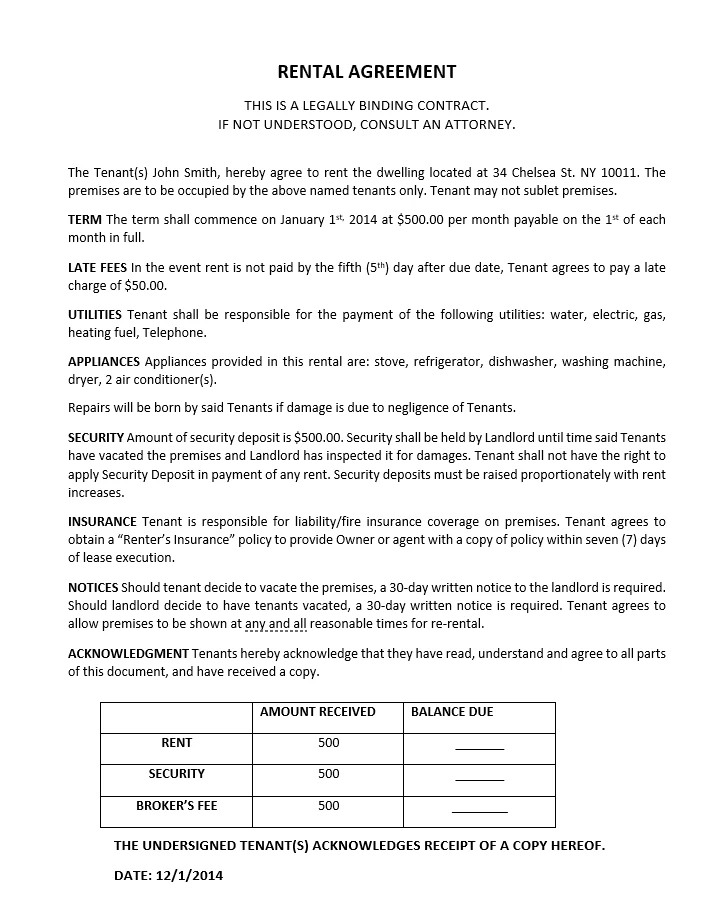
Sample Rental Agreement
Besides automating the process, here are more ways businesses can benefit from data extraction tools:
Enhanced data quality
Imagine, how taxing would it be for, let's say, a marketing executive to obtain important customer information trapped in hundreds of PDF files. If the executive wants to extract email addresses from these files, they'll end up wasting time. This can also result in errors, such as incomplete records, missing information, and duplicates. Data extraction tools not only guarantee valuable business insights but they also ensure data quality.
Better scalability
Businesses regularly deal with large volumes of data that they need to process and analyze. Data extraction tools are designed to handle such scale. These tools utilize parallel processing and batch processing techniques to extract data in bulk, making it feasible to process it in a timely manner.
Integrated business intelligence
Data extraction tools integrate with business intelligence (BI) systems, data warehouses, and data analytics tools, enabling businesses to consolidate data from multiple sources into a central repository. Businesses can then analyze and transform this data into meaningful insights to formulate effective business strategies.
Compliance and risk management
Data extraction tools employ algorithms that accurately extract data from documents, minimizing the risk of errors or omissions that can occur during manual extraction. Accurate extraction ensures that the relevant data is captured and processed in a compliant manner. Modern data extraction tools can be configured to handle sensitive or personally identifiable information (PII) with privacy in mind. They can automatically identify and redact or anonymize sensitive data elements to ensure compliance with privacy regulations such as General Data Protection Regulation (GDPR) or California Consumer Privacy Act (CCPA).
Better analysis and decision-making
A study conducted by Forrester revealed that not more than 0.5 percent of the world's data is analyzed and used. With the help of a unified data extraction tool, businesses can easily extract meaningful information hidden in unstructured data sources. These tools can also combine the extracted data with sales, product, marketing, or any other type of data to gain more insights.
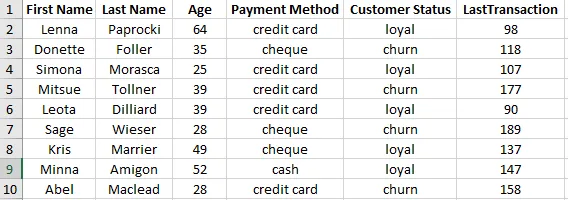
Sample Customer Data
Accelerate Data Extraction with Astera's AI-Powered Platform
Extract data from unstructured documents within seconds and reduce processing time by up to 15 times. Try our AI-powered extraction tool today.
Download Your Free 14-day Trial!
How do data extraction tools work?
Data extraction tools utilize OCR, AI, and ML algorithms to extract and process data from multiple sources. A unified data extraction tool, or an AI-document processing solution, combines these features together to simplify the extraction process. Compared to traditional manual data extraction methods, data extraction tools offer significantly higher levels of accuracy, efficiency, and scalability.
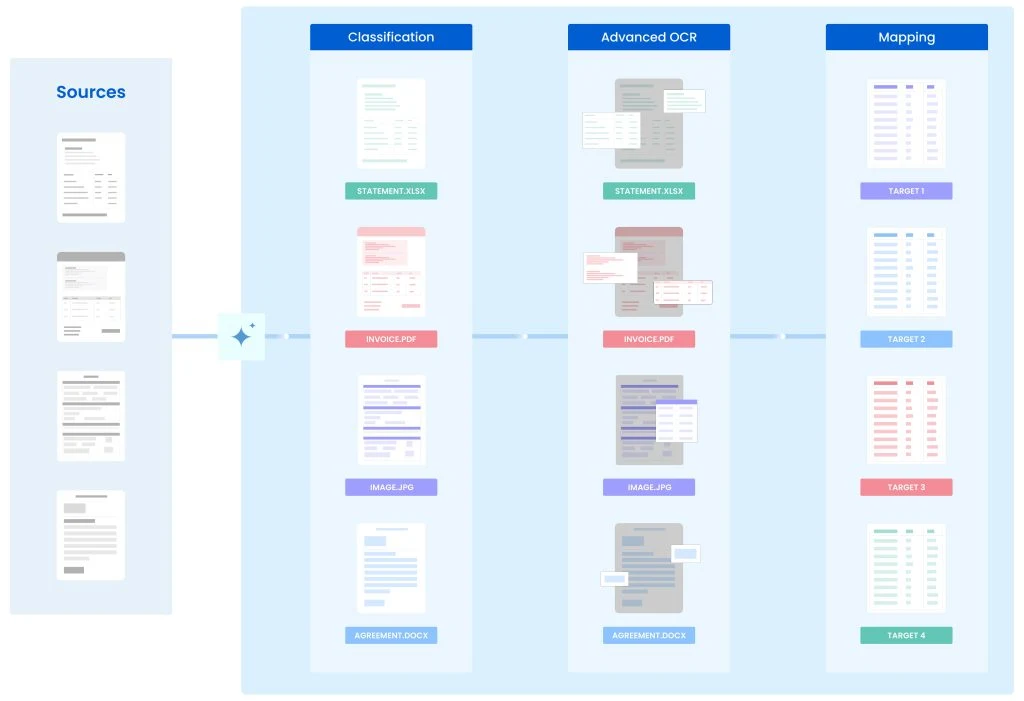
Data extraction tool workflow classifying source documents, applying advanced OCR and mapping fields to target datasets
Here's a step-by-step explanation of how these tools generally work:
Document Input: The user imports or uploads digital documents, such as scanned images, PDFs, or electronic files, into the tool. Specialized data extraction software allows bulk document import, saving countless hours.
OCR Processing: The tool uses OCR to analyze the visual elements of the document and generate a digital representation of the text content. Then it recognizes characters and converts them into text that's machine-readable and searchable.
Preprocessing: Next, the tool analyzes and preprocesses the OCR-generated text. This step can involve removing noise, correcting errors, handling different languages, and normalizing the text.
Feature Extraction: ML algorithms extract relevant features from the preprocessed text. These features may include word frequency, position, font style, layout information, or other characteristics that help distinguish different data fields.
Data Extraction and Classification: The ML models are used to extract data from preprocessed documents. To do so, it analyzes the preprocessed text, identifies patterns based on the learned features, and classifies the extracted information into the desired data fields.
Data Validation and Verification: Extracted data then undergoes validation and verification processes to ensure accuracy and reliability. This can involve rule-based checks, comparison with existing data, or human review for quality assurance.
Output and Delivery: The extracted data is typically structured and delivered in a usable format for further analysis, integration, or reporting. This can include exporting the data to databases, spreadsheets, APIs, or directly integrating it into other business systems.
The 11 best data extraction tools in 2026
Tool | Best For | Watch Out For |
Astera | No-code, AI-powered extraction across financial, medical, and unstructured documents at scale | — |
Talend (Qlik) | Technical teams integrating data across many source types | Steep learning curve for business users |
Import.io | E-commerce web scraping | Marketed as no-code, but reviewers report it often needs coding |
Parseur | Small-volume PDF/email extraction | Struggles past ~100 pages; layout changes need a new template |
Improvado | Marketing and sales data extraction | Learning curve without a database/transformation background |
SAS Data Management | Database-heavy environments needing custom connectors | Expensive; some scenarios still require coding |
Docsumo | Straightforward, consistent PDF/TIFF workflows | Layout changes require retraining the AI model |
Web Scraper | Lightweight scraping of dynamic, JS-heavy sites | Narrower scope than full extraction platforms |
Nanonets | AI document processing across varied document types | Can get costly at low volume; limited model transparency |
Docparser | Multi-format document parsing | High per-document cost; UI can overwhelm non-technical users |
Docspire (by Astera) | AI document extraction for accounts payable, mortgage, and forms processing — live in under 5 minutes with no templates or model training | Custom pricing only; higher accuracy tiers require paid plans |
Astera
Astera offers an intelligent, end-to-end data management platform that enables you to access, extract, integrate, transform, and load data into your destination of choice. Whether your source data is in PDF, Word, XLS, JSON, HTML XLSX, PRN, RTF, CSV, EDI, a database, or even a data warehouse, use Astera's drag-and-drop user interface and built-in connectors to quickly retrieve the data points you need.
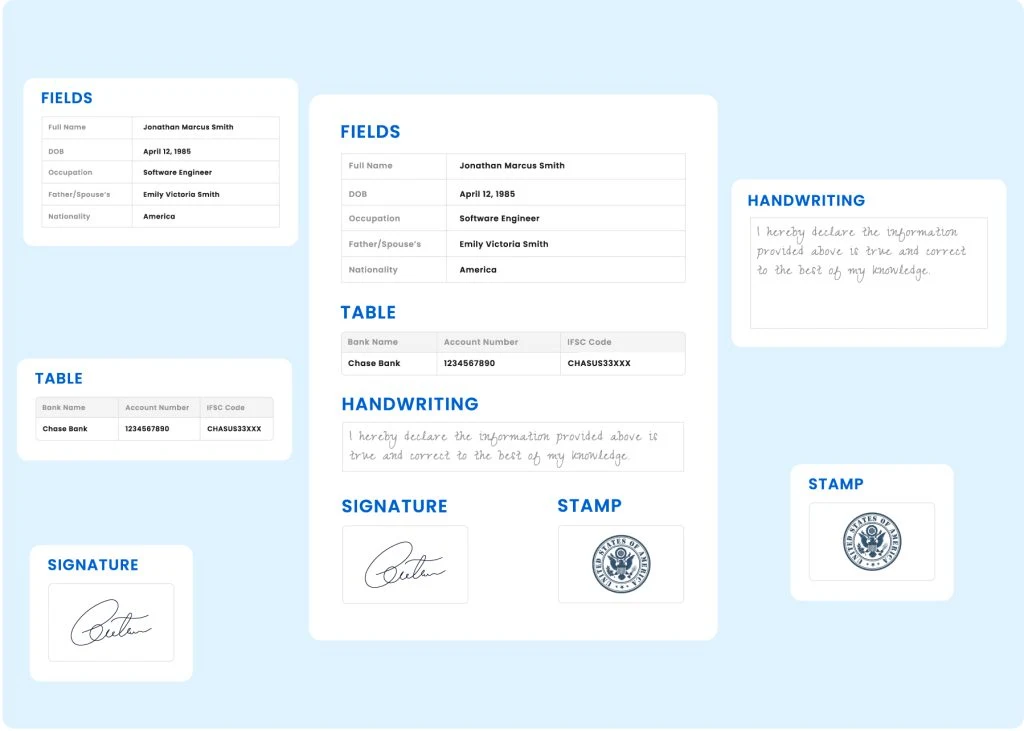
Data extraction software capturing fields, tables, handwriting, signatures and stamps from a scanned document
Here's why businesses of all sizes love our data extraction solution:
Being 100% no-code and fully automated means even business users can use it
Astera Intelligence uses AI-powered intelligent document processing to automatically adapt to each document's unique format, even with varying layouts, including financial reports, bills, legal contracts, medical records, invoices, etc.
The ability to process key-value pairs, tables, and even complex line items with unparalleled accuracy
The ability to quickly convert data across several formats using advanced text converter and optical character recognition (OCR)
The integration of large language models (LLMs) and multi-agent AI systems enables multi-page processing of large documents with human-like comprehension, ideal for industries like legal, financial services, and healthcare
Parallel processing enables you to process a large volume of documents simultaneously
The ability to tailor AI models to your specific use cases and get reliable results even with unstructured sources
The ability to build custom data connectors and extract data from an even wider collection of sources
Astera's data extraction platform ensures compliance with industry standards and regulations
And much more—without writing a single line of code.
CoWorx Staffing reduces payroll data consumption time by 95% with Astera
CoWorx Staffing uses Astera's intelligent document processing solution to cut down data extraction and integration time from 4 hours to 10 minutes. See what they have to say about Astera.
Talend (acquired by Qlik)
Talend is a data integration platform that enables users to extract data from multiple data sources, transform it and load it into a database or a data warehouse. Like Astera, it offers a user-friendly interface to simplify the data extraction and integration process.
Keep in mind that Talend is best suited to users that have a technical background, which means business users must deal with a considerable learning curve.
Read more: Talend alternatives for data extraction and integration.
Import.io
Import.io is a web scraper that specifically focuses on the e-commerce segment and enables web data extraction from multiple websites. With Import.io users can scrape specific sections of websites by providing example patterns, getting access to the data points you need.
Although it states it's fully no-code, users on review websites have reported otherwise—your team needs to be able to code to get the requisite data.
Parseur
As AI-data extraction software, Parseur offers a platform that automates text extraction from PDFs, emails, and a limited number of other sources. It uses AI and OCR for PDFs, and text templates for emails and documents.
While Parseur's AI parsing engine supports multiple document types, its effectiveness is limited to around 100 pages and is dependent on language. Additionally, its OCR engine requires a separate template whenever the document layout changes.
Improvado
Improvado enables businesses to extract marketing and sales data to inform decision-making. Like other data extraction tools, it offers an easy-to-use interface and supports multiple integrations allowing different teams to access and extract data from various sources.
According to reviews submitted by business users, Improvado has a steep learning curve, especially if users do not have sufficient experience with databases and data transformation.
SAS Data Management
As the name suggests, SAS Data Management is a platform that enables users to manage, integrate, and transform data. As with Astera, users can build custom connectors using SAS Data Management to integrate the data sources of your choice and extract data from them. While it supports file formats like XML, CSV, and JSON, it's more adapted to accessing and retrieving data from databases.
Although the breadth of solutions offered by SAS Data Management is comparable to those offered by other data extraction vendors, it's much more expensive. The fact that users need to code in certain scenarios, especially where specific knowledge is required, doesn't help either.
Docsumo
Docsumo is a document workflow automation platform that leverages AI to extract data from unstructured documents. With Docsumo, users can ingest, classify, and preprocess documents in different formats, such as PDF, TIFF, etc.
Implementing Docsumo is largely dependent on the types of documents used. Like any other data extraction tool, it can process straightforward documents easily. For documents with changing layouts, however, the tool requires time and effort to train the AI models to extract data accurately.
Web Scraper
Web Scraper is a lightweight data extraction tools to extract information from dynamic websites. The tool is capable of handling JavaScript websites and using sitemaps to customize data. Users can build their scrapers to crawl and scrape websites and export data in commonly used formats like CSV, XLSX, and JSON.
Nanonets
Nanonets is another AI-powered data extraction tool capable of processing various documents and extracting data. Like Astera, Nanonets can process and convert unstructured documents, such as purchase orders, healthcare forms, invoices, bills of lading, and bank statements, into structured information.
According to review websites like G2, Nanonets can get particularly expensive, especially for low volume scenarios. Additionally, a lack of visibility into how the models operate and make decisions can create operational and trust-related challenges.
Docparser
Docparser is document parser software that enables users to extract data from multiple document types and formats and load to various destinations. Like most modern data extraction tools, it uses AI to speed up extraction times and process unstructured documents.
Although Docparser features a visual UI, non-technical and business users can be easily overwhelmed and confused by the features when creating data parsing workflows. Additionally, according to user reviews, the cost per document is high.
Docspire
Docspire is an AI-powered document extraction platform purpose-built for document-heavy operations like accounts payable, mortgage processing, and forms handling. It processes invoices, bank statements, tax documents, ID records, and 40+ other document types across PDF, image, Excel, CSV, Word, and EDI formats, with accuracy up to 99.5% across 40+ languages. The data extraction tool uses adaptive OCR, context-aware AI, and configurable business rules — no template creation or model training required, and it can go live in under 5 minutes. Docspire also includes built-in validation rules, real-time document tracking with full audit trails, and intelligent approval routing.
Pricing is custom and not publicly listed, and higher accuracy tiers require a paid plan.
Try Astera's AI-Powered Data Extraction Tool
Don't fall for partially automated data extraction solutions. Opt for Astera's AI-powered data extraction and integration platform and automate your workflows from end to end. Try free for 14 days.
Transform Your Document Processing with NLP and LLM
Combine NLP’s precision and LLM’s versatility. With Astera’s cutting-edge IDP solution, you can extract, process, and analyze documents effortlessly. Try it out for yourself!
Contact Us
Features to look for in a data extraction solution
While most disparate data extraction tools may combine multiple functionalities or overlap across categories, they do not provide all the additional features, capabilities, and a unified experience that a single comprehensive data extraction platform can offer. Therefore, it is utmost important to always keep business requirements at the forefront when deciding on a tool or vendor.
A few important points that an organization should consider while looking for a robust data extraction solution include:
Built-in AI capabilities
Given the number of documents and the amount of data produced daily, AI capabilities have become a standard offering in modern data extraction solutions. These include natural language processing (NLP) to understand document context, machine learning (ML) for adaptability to diverse document types, and intelligent classification for unstructured and semi-structured data. Ensure the tool you select is AI-ready.
User-friendly interface
It is important for data extraction tools to have an intuitive user interface where business users are easily able to retrieve the data points they need and, if needed, build their own AI pipelines to extract data.
Support for multiple formats
Organizations receive data in in all shapes and sizes, from structured to semi-structured and even unstructured formats. While most BI tools can process structured formats directly after some scrubbing, automated data extraction software help businesses in structuring the unstructured data sets. These tools also support a wide range of unstructured formats, including DOC, DOCX, PDF, TXT, and RTF, enabling businesses to make use of all the information they receive.
Real-time data extraction for big data analysis
Having timely access to data is imperative for optimal decision-making and smooth business operations. Many businesses are dependent on batch data extraction, which processes data sequentially depending on the requirements.
This means that the information available for analysis might not reflect the most recent performance data. Any crucial business decisions made will be based on outdated data. Hence, an effective data extraction tool should enable real-time extraction using workflow automation and process orchestration to prepare data faster for BI initiatives. Modern data extraction tools leverage AI techniques and ML algorithms for real-time data extraction.
Reusable templates with data extraction software
The right data extraction software should allow the user to build an extraction logic that they can apply to any unstructured document of the same layout. This eliminates the need to build extraction logic anew for each incoming document with a similar layout.
Built-in data quality & cleansing functionality
The data extraction tool should be able to identify any errors and cleanse the data automatically according to business rules defined by the user. For example, if a company uses an extraction model to extract order quantities and order details from PDF invoices, it should be able to detect and delete any orders with negative quantity values.
Support for multiple destinations
Modern data extraction tools support a wide variety of destinations. With this flexibility, users can easily export the converted data to the destination of their choice, such as SQL Server, Oracle, PostgreSQL, and various BI tools like Tableau. This enables businesses to access meaningful information faster without setting up additional integrations.
Here's what to do next: streamline data extraction with Astera
Modern problems require modern solutions, which means basic data capture is no longer enough. Businesses need more intelligent data extraction and document processing solutions that integrate AI capabilities into the extraction workflow, lie Astera.
What truly sets Astera apart is its end-to-end platform that doe much more than just extract data. With Astera, you can:
Combine multiple data sources to extract the data you need
Auto-generate document layouts instantly, even for unstructured documents
Transform data to suit your business needs and match the destination format
Optimize data quality to ensure only healthy data reaches your target systems
Load data to the destination of your choice, whether on-premises or in the cloud
Automate the entire data extraction and integration pipeline
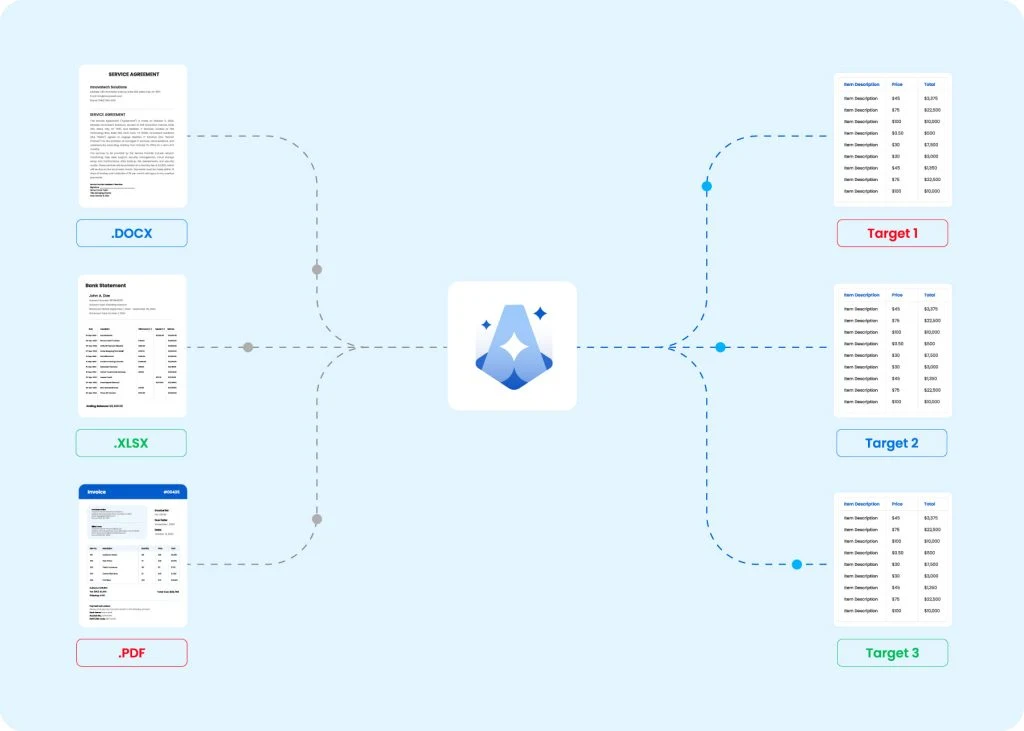
Astera AI-powered data extraction routing DOCX, XLSX and PDF documents into three structured target datasets
If you have unstructured data coming your way, try Astera and find out how you can streamline data extraction from all your data sources.